
CORE PHYSIOTHERAPY
Surgical Support
Your recovery starts before surgery. Whether you’re
preparing for an upcoming procedure or working through
your recovery, our physiotherapy team supports you
every step of the way.
Less Pain
Prehabilitation reduces pain before hip, knee, spinal & ankle surgery
Punnoose et al., JAMA Network Open, 2023 · Rhim et al., Foot & Ankle, 2024
3,570
Patients across 48 trials showing prehab improves orthopaedic surgery outcomes
Punnoose et al., JAMA Network Open, 2023
Better Outcomes
in strength, function & quality of life with post-surgical physio
Esen et al., European Spine Journal, 2025
BEFORE YOUR SURGERY
Prehabilitation – Prepare Your Body to Heal Faster
Think of prehabilitation as getting your body in the best possible shape before surgery. The stronger and fitter you are going in, the better and faster you recover coming out.
Assessment & Goal Setting
We assess your current strength, mobility and fitness, and set a clear plan tailored to your surgery type.
Targeted Exercise Program
Exercises focused on the muscles around your surgical site, plus breathing and cardiovascular conditioning.
Balance & Falls Prevention
Many patients awaiting surgery are at greater risk of falls. We include balance training and safe movement strategies to keep you safe and confident at home before your procedure.
Education & Preparation
We walk you through what to expect after surgery — including safe movement, pain management, and what your recovery will look like week by week.
Weight Management & Surgical Clearance
Some surgeons require patients to reach a healthy BMI before surgery. Our physio and exercise physiology team support medically guided weight loss through safe, structured exercise.
Equipment & Mobility Aids
Where needed, we organise and fit mobility aids, crutches, walking frames, or braces so you’re confident and safe before you leave for hospital.
RESEARCH-BACKED
1-2 days
shorter hospital stay for patients who complete a prehabilitation program — supported by a landmark review of 48 trials.
Sources: de Moura et al., Journal of Physiotherapy, 2024 · Punnoose et al., JAMA Network Open, 2023
Strength & Pain Science
Go in stronger.
Surgery causes temporary muscle loss. The stronger and more pain-aware you are before your procedure, the faster and more confidently you’ll recover.
Research shows high-certainty evidence that prehabilitation reduces pain and improves muscle strength before hip, knee, and spinal surgery.
Source: Punnoose et al., JAMA Network Open, 2023
Suitable Before
Joint ReplacementsACL RepairHeart Surgery
Spinal SurgeryAbdominal SurgeryThoracic Surgery
Pre-Surgery Weight Management
Types of Prehabilitation
Tailored to Your Support Surgery
Every surgery is different, and so is every prehabilitation program.
Our team tailors your program to the specific demands
of your procedure and your individual starting point.
Orthopaedic Prehab
Joints, ligaments & spinal surgery
- Strengthening muscles around the surgical site
- Improving range of motion
- Teaching post-operative exercises before joint replacements, ACL repairs, or spinal surgeries
Cardiac Prehab
Heart surgery preparation
- Cardiovascular conditioning before heart surgery
- Improve exercise tolerance and reduce complications
- Particularly important for high-risk patients
Pulmonary Prehab
Thoracic & major abdominal surgery
- Breathing exercises and airway clearance techniques
- Respiratory muscle training
- Prevention of post-operative pneumonia
General Surgical
Conditioning
Major procedures
- Overall fitness optimisation and core strengthening
- Mobility training before major procedures
- Reducing complication risks through physical resilience
Neurological
Prehab
Planned neurosurgical procedures
- Maximising existing function before surgery
- Preparing for post-operative rehabilitation needs
- Tailored to planned neurosurgical procedures
Core
Hydrotherapy
Low-impact conditioning
- Improving cardiac fitness, strength, and mobility
- Minimising joint stress
- Ideal for chronic pain patients or those who struggle with land-based exercise
Complex Presentations
Chronic Pain & Complex Injury Prehabilitation
For patients with chronic pain or complex injuries, prehabilitation goes beyond standard exercise preparation. Most pain specialists recommend comprehensive physiotherapy assessment before any interventional procedure – and for good reason.
Chronic pain conditions often involve altered movement patterns, muscle weakness and imbalances, pain sensitisation, and fear avoidance behaviours. Addressing these factors before surgery can significantly improve your outcomes.
The Treatment Window Strategy
Procedures like cortisone injections provide a temporary 4–6 week window of reduced inflammation. We use this period to restore normal movement patterns and build strength in previously painful areas — making the most of the relief while it lasts.
Pain Specialist Procedures We Support
Nerve blocksNeuromodulationPulsed RFN
Spinal cord stimulatorsDRG stimulator implants
Cortisone injectionsHyaluronic acid injections
Epidural steroid injections
Complex Case Management
Comprehensive movement analysis
Understanding how pain has changed the way you move.
Graded exposure therapy
Gently reducing fear of movement at a pace that feels safe
Pain science education
Helping you understand what pain means and why it doesn’t always equal damage
Multidisciplinary coordination
Working alongside your surgeon, pain specialist, and GP
Realistic goal setting
Building a plan around what matters most to you
During Your Hospital Stay
In-Hospital Care
Our team doesn’t visit you in hospital — but you’re well looked after. The day
after surgery, hospital staff will check in, support your early movements,
and confirm you’re safe to go home. Then we take it from there.
In Hospital — What to Expect
What hospital staff typically cover:
First steps and safe mobility
Breathing exercises and chest complication prevention
Transfer training – bed to chair, bathroom, walking
Pain management and wound care guidance
Coming Home — Where Core Takes Over
From the moment you’re home, your Core physio guides your recovery — progressing your program each week as your strength and mobility improve.
First appointment arranged before surgery or discharge
Equipment fitting and mobility aid training where needed
Personalised home exercise program from day one
Clear guidance on what to do — and what to avoid
Weekly progression tailored to your recovery
Seamless Transition
No gap in your care.
Plan ahead – book your first appointment before surgery, or before you leave hospital. Having a plan in place means no gap in your care when it matters most.
Why Guided Recovery Matters
Up to 50%
of patients don’t fully follow unsupervised home exercise programs — which can slow recovery or lead to setbacks.
Your physio doesn’t just give you exercises — they check your technique, track your progress, and adjust your program each week as your body heals.
Source: Holden et al., Physiotherapy, systematic review on adherence to rehabilitation — PubMed indexed
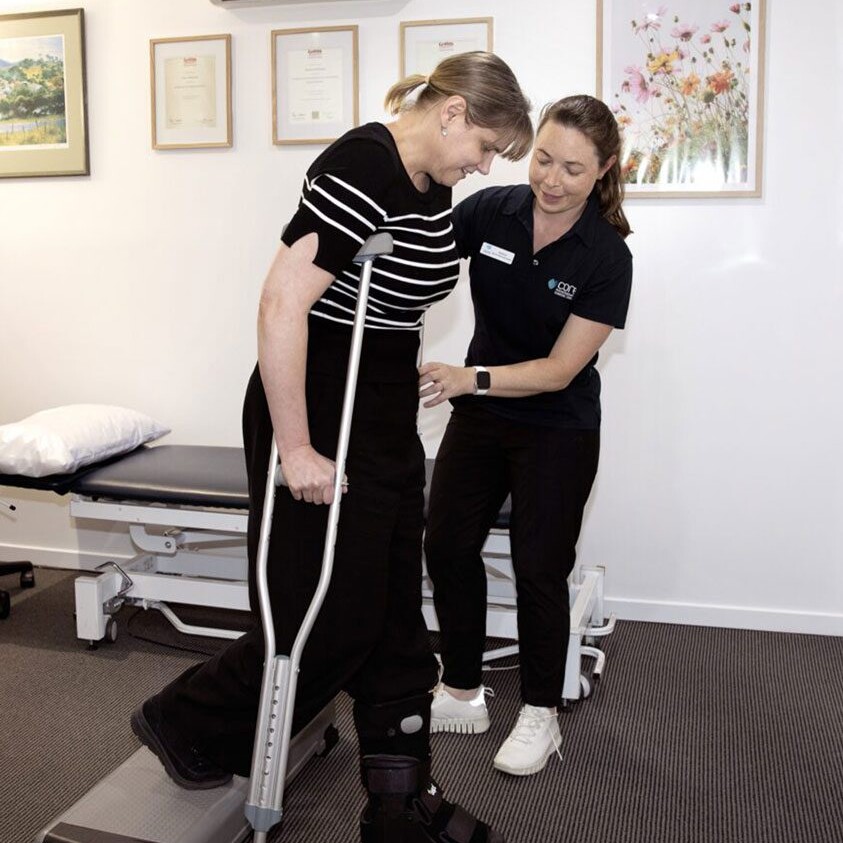
After Your SurgerY
Post-Surgical Rehabilitation – Your Recovery, Step by Step
Surgery fixes the structure – physiotherapy restores the function. Our team works closely with your surgeon to guide your recovery from the day you come home.
Weeks 0–2
Protection, Early Movement & Falls Safety
Managing pain and swelling, gentle mobility, and personalised falls prevention guidance — especially important in the first days home when fatigue and reduced balance increase your risk.
Weeks 2–6
Restoring Range of Motion
Targeted exercises to restore flexibility and address scar tissue early – keeping your joint mobile and reducing the risk of long-term stiffness.
Weeks 6–12
Rebuilding Strength
Progressive strengthening adjusted each session to how your body is responding — building stability and function at a pace that challenges without setting you back.
3–6 Months
Return to Life, Work & Sport
Goal-specific rehabilitation tailored to what matters most to you, with return-to-activity clearance agreed alongside your surgical team.
Specialised Rehabilitation by Procedure Type
Our physiotherapists have extensive experience across the full range of orthopaedic,
neurological, cardiothoracic, and general surgical procedures.
Foot & Ankle
Fracture repairs, Achilles reconstruction, bunion surgeries, plantar fasciitis release, and complex trauma reconstruction.
Knee
Arthroscopic procedures, meniscus repairs, ACL/PCL reconstruction, total and partial knee replacement, and multi-ligament rehab.
Hip
Total and partial hip replacement, hip arthroscopy and labral repairs, fracture repairs, and complex trauma and revision surgeries.
Spine, Neck & Back
Spinal fusion, disc replacement, laminectomy, microdiscectomy, nerve decompression, and complex spinal reconstruction.
Shoulder
Rotator cuff repair, shoulder replacement, labral repairs, instability, impingement, and frozen shoulder release.
Elbow, Wrist & Hand
Carpal tunnel releases, tendon repairs, tennis/golfer’s elbow, fracture rehab, TFCC repairs, and wrist arthroscopy.
Neurological
Motor relearning, neuroplasticity training, balance and coordination retraining, and spasticity management following neurosurgery.
Cardiothoracic
Respiratory function restoration, cardiovascular conditioning, graduated activity progression, and return to work planning after heart or lung surgery.
Abdominal & Gynaecological
Core restoration after hernia repair, bowel surgery, hysterectomies, prolapse repairs, Caesarean sections, and pelvic floor dysfunction.
Complex Pain
Chronic Pain & Complex Injury Rehabilitation
Not all post-surgical pain resolves on its own. For patients experiencing persistent or complex pain,
we offer specialist rehabilitation that goes beyond standard recovery programs.
Persistent Pain Management
Evidence-based specialist care
For persistent or complex post-surgical pain, our approach goes beyond standard rehab — combining pain science education, graded motor imagery, desensitisation, movement retraining, and flare-up management.
Complex Regional Pain Syndrome
CRPS specialist treatment
- Graded motor imagery protocols
- Desensitisation and normalisation techniques
- Progressive loading programs
- Sympathetic nervous system regulation
- Coordinated multidisciplinary team approach
Pain Specialist Procedure Rehabilitation
Post-procedural physiotherapy support for patients who have undergone interventional pain procedures:
Nerve block & ablation procedures
Movement progression in the treatment window
Spinal cord stimulator optimisation
Function and activity progression post-implant
Dorsal root ganglion stimulator
Device-specific education and adjustment support
Injection site care
Targeted rehab during the anti-inflammatory window
Personalised Recovery Support
PhysiApp – Your Recovery in Your Pocket
PhysiApp bridges the gap between clinic visits, giving you professional guidance 24/7 throughout your recovery journey.
iOSAndroid
Video demonstrations
Prescribed exercises shown clearly so you always know you’re doing them correctly
Progress tracking
Adherence monitoring so your physio can see how you’re going between sessions
Exercise modification
Your program adapts based on your recovery stage
Direct communication
Message your physiotherapist with questions without waiting for your next appointment
Our Locations
Ready to take the Next Step?
Our team is here to support you – before, during, and after your surgery.
Contact us to book an assessment at a clinic near you.
Book Appointment
To begin, book your initial consultation.
Have Questions? We’re Here to Help
Phone
Fax
1300 633 546