
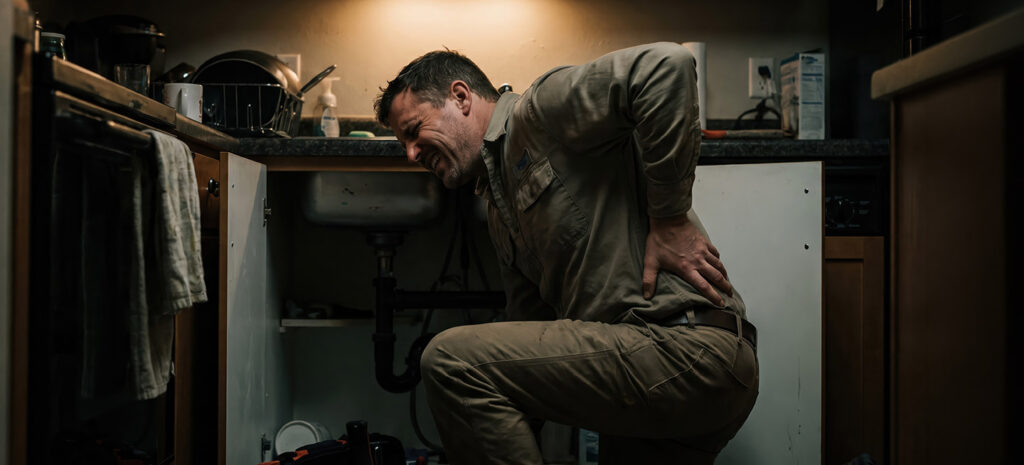
Clinical name: Acute facet joint locking / muscle spasm (often described by patients as a “pinched nerve”)
Direct answer
A sudden, sharp “catching” or “pinching” pain in the back — often on bending, twisting, or standing up from a bent position — is very commonly described by patients as a “pinched nerve,” but in most cases it isn’t actually nerve-related at all. It’s far more often a small facet joint briefly locking or catching, or an episode of acute muscle spasm, both of which respond well to the right early treatment.
What this means
A genuine “pinched nerve” causes numbness, tingling, weakness or pain travelling along a specific nerve pathway, usually down a leg (see our related article on sciatica). The sharp, localised “catch” or “grab” that many people call a pinched nerve is usually coming from a small joint in the spine or the surrounding muscles, not a nerve at all.
How can I tell the difference?
True nerve involvement typically comes with numbness, tingling, weakness, or pain radiating down an arm or leg in a specific pattern. A facet joint catch or muscle spasm tends to cause sharp, localised pain right at the spot, often triggered by a specific movement, without those spreading nerve-type symptoms.
Why does it happen so suddenly?
Facet joints can briefly catch or lock when a movement combines an awkward angle with unexpected load — often something as simple as reaching for something or twisting to grab an item from the back seat. The surrounding muscles then spasm protectively, which is often what causes the most pain in the hours and days that follow.

What tends to aggravate it, and what helps ease it?
The specific movement that triggered it — and similar movements — tend to aggravate it further in the short term, along with prolonged stillness that lets the area stiffen up. Gentle, guided movement, manual therapy to help settle the joint and surrounding muscle spasm, and gradually reintroducing the aggravating movement pattern tend to resolve it fastest.
Does this need imaging?
Usually not — this is a clinical diagnosis based on your history and a physical assessment, and it responds well to hands-on treatment and guided movement without needing a scan in most cases.
How long does it usually take to settle?
Many episodes settle within a few days to two weeks with appropriate treatment, though the muscle guarding and stiffness can sometimes linger a little longer if the underlying joint restriction isn’t addressed directly.
Who’s behind this advice
Reviewed by: Core Healthcare Banyo 2026
Clinic services: Assessment and diagnosis of back pain and related symptoms (including leg, buttock and pelvic pain); manual therapy; individualised treatment and management planning based on your assessment findings; Pilates-based rehab classes, strengthening and exercise rehabilitation, including musculoskeletal and sports rehab; posture and workstation advice; women’s health physiotherapy for pregnancy-related back and pelvic pain.
Related reading
• Pain shooting down my leg from my back — is this sciatica?
• My back pain keeps coming back — how do I stop the cycle?
• I’ve hurt my back lifting or twisting — what should I do?
Next step
Back pain that’s left to “settle on its own” often takes longer to resolve and comes back more easily than back pain that gets an early, targeted assessment. A proper assessment identifies exactly what’s driving your symptoms and gets you started on a specific plan — not just advice to rest and see how it goes. Book a back assessment with a physiotherapist at any of Core Healthcare’s seven clinics across Brisbane, Logan, the Gold Coast and Northern NSW, or ask your physio about this at your next session.