

At first glance your shoulder seems to be a ball and socket joint, however, the socket is more like a small shallow dish and the ball requires a combination of lots of small ligaments and muscles to hold it in place. The rotator cuff is the group of four muscles and their tendons that is responsible for not only keeping the ‘ball’ of your shoulder in place against the shoulder blade but also the movement and rotation of your arm. Whereas, your bursa is a tiny, fluid sack responsible for reducing friction between the rotator cuff tendons and the bones in the shoulder.
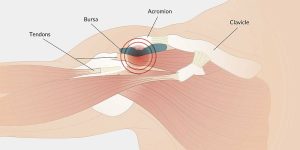
What is it?
Shoulder impingement syndrome is an extremely common condition where either your rotator cuff tendons or bursa are compressed or pinched against the AC joint (the bone on the tip of your shoulder) while raising your arm. Shoulder impingement is the cause of around 50% of all shoulder pain complaints, making it one of the most commonly treated shoulder pain conditions treated by physiotherapists.
Causes
Shoulder impingement is most common in people who repeatedly use their arms overhead such as swimmers, tennis players, volleyball players, or cricketers. Moreover, those who participate in repetitive overhead weight lifting, or other activities that involve raising your arms overhead, such as construction and painting. Simply put, shoulder impingement is an overuse injury that causes the tendons in your shoulder to swell, leading them to pinch/catch on your AC joint. Ageing and previous injury such as a dislocated shoulder are also factors that increase the risk of shoulder impingement.
Signs and symptoms of shoulder impingement
The primary symptom of shoulder impingement syndrome is pain and stiffness whilst lifting your arm, along with general swelling and tenderness in the front of the shoulder. Other symptoms may include:
- Radiating pain that goes from the front of your shoulder to the side of your arm
- Pain and discomfort during sleep
- Loss of strength
- Loss of range of motion
- Constant minor pain in your arm
Diagnosis and Treatment
Our Physiotherapists are extremely well trained to assess and diagnose shoulder impingement, which is done through a series of questions and physical tests, particularly assessing your range of motion and strength. These tests will also assist in ruling our other conditions such as rotator cuff tears, or pain coming from your neck. In some cases, scans such as an ultrasound or MRI may be necessary to rule out any more serious rotator cuff injuries.
Relative rest is key in shoulder impingement treatment – you should avoid any exercises or movements that cause your pain to become worse. Try icing the area a few times a day to reduce pain and swelling around the affected area. Physiotherapy will be utilised to strengthen the muscles in your shoulder and the surrounding areas to alleviate your symptoms. Physio also includes local soft tissue therapy, correction of scapula posture, reduced soft tissue tightness and ergonomic training. In the most extreme cases, surgery to widen the space around your rotator cuff may be necessary.
Prognosis
Shoulder impingement syndrome has a positive prognosis when diagnosed early, with progressive improvement possible within 4-6 weeks and full recovery taking 3-6 months. In the more severe cases, the recovery process may take up to or over a year.
If you need help with pain or immobility to get you moving again, or need a tailored exercise program, book in for your treatment now with one of our exercise, physio, or pain specialists via 1300 012 273 or head to our website and book a session at your nearest clinic.